

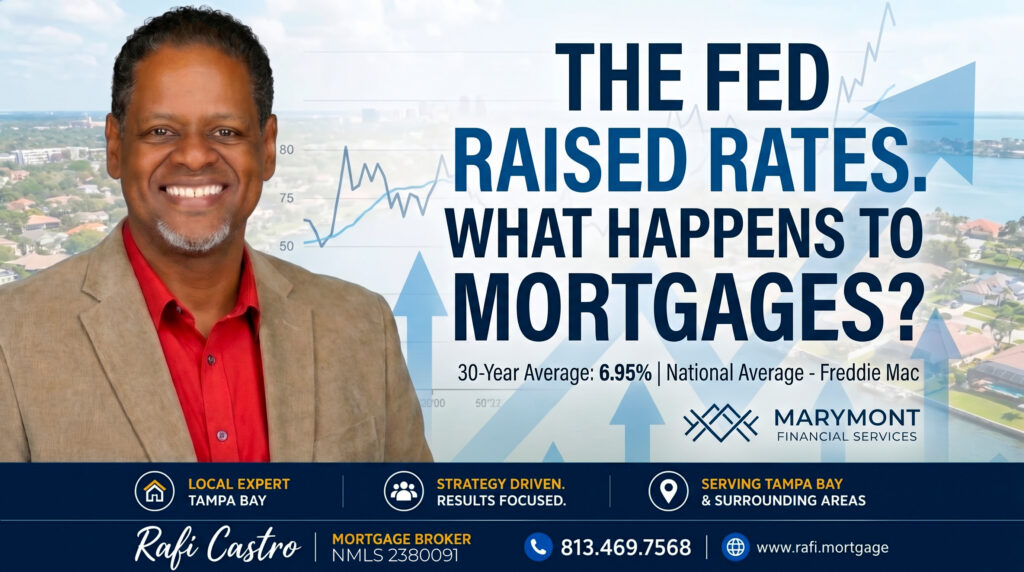
The Fed raised rates in September 2026 while mortgage rates approached 7%. Learn why the Fed does not directly set mortgage rates and what Florida homebuyers should watch next.
For context on whether now is a good time to buy, see Redfin’s analysis: Is Now a Good Time to Buy a House?
The Fed Raised Rates. Here’s What Florida Homebuyers Should Actually Know…
The Federal Reserve raised its benchmark interest rate by 0.25 percentage points on September 16, bringing the federal funds target range to 3.75%-4.00%. It was the central bank’s first rate increase in more than three years. For homebuyers, the natural reaction is to assume mortgage rates increased because the Fed raised rates. That explanation is incomplete.
The Fed Does Not Directly Set Mortgage Rates
The Federal Reserve controls a very short-term interest rate. A 30-year mortgage is a long-term financial instrument. Mortgage rates are influenced much more directly by the bond market, particularly mortgage-backed securities and movements in longer-term Treasury yields. The Fed matters because its policy affects expectations for inflation and economic growth, but mortgage rates do not simply rise or fall by the same amount as a Fed rate change. Understanding that distinction can help buyers make better decisions in a volatile market.
Mortgage Rates Are Near 7%
Freddie Mac reported September 17 that its national average 30-year fixed mortgage rate increased to 6.95%, up sharply from 6.76% the previous week. That was the highest Freddie Mac weekly average since January 2025. Other daily mortgage-rate indexes have moved above 7%. The difference illustrates why borrowers may encounter multiple mortgage-rate numbers in the news. Freddie Mac’s survey captures a weekly average, while daily indexes react faster to changing bond markets. Neither is a personalized mortgage quote. Actual pricing depends on credit profile, loan program, property type, occupancy, down payment, points and other factors.
Sources: Freddie Mac, Mortgage News Daily
Why the 10-Year Treasury Matters
The 10-year Treasury yield briefly moved above 5% this week, reaching levels not seen since 2007. On Thursday it pulled back to approximately 4.96% after being around 5.02% Wednesday. Mortgage rates and the 10-year Treasury do not move in perfect lockstep, but they frequently move in the same general direction. Mortgage-backed securities must compete with Treasury securities for investor capital. If investors can receive a higher yield from highly liquid U.S. government debt, mortgage securities generally need to offer enough return to remain attractive. That can translate into higher mortgage rates.
Why Did the Fed Raise Rates?
Inflation remains a central concern. Federal Reserve officials indicated after Wednesday’s meeting that recent inflation readings had not improved enough and that additional tightening could be necessary. Markets had already anticipated Wednesday’s move. That is another reason mortgage rates do not simply wait for the Fed announcement and then move by the same amount. Bond investors continuously price expectations about future inflation, economic growth and Federal Reserve policy.
Florida Housing Is Leveling Off
While mortgage rates dominate national headlines, newly released August data shows Florida’s housing market continuing to stabilize. Single-family closed sales declined approximately 1.5% year over year. Condo and townhouse closed sales declined just under 2%. But single-family inventory fell approximately 13% from a year earlier, while condo and townhouse inventory fell approximately 11.5%. Florida’s median single-family sale price increased slightly to approximately $415,000. The combination suggests a market finding a new balance rather than moving dramatically in one direction.
Tampa Buyers Are Getting a Mixed Market
Tampa’s August numbers illustrate why local market analysis matters. The Tampa metro median listing price declined to approximately $390,000, down 6% year over year. But active inventory also declined 6.4% to 17,996 listings. About 25.5% of listings had a price reduction, and the median property spent 74 days on the market. That means buyers may find negotiating opportunities without necessarily having unlimited inventory. The market can vary significantly by neighborhood, property type and price point.
Higher Rates Change the Negotiation
When mortgage rates rise, the purchase price becomes only one part of affordability. Buyers should consider the complete monthly housing expense: principal and interest, property taxes, homeowners insurance, flood insurance where applicable, HOA or CDD assessments and mortgage insurance when required. Financing structure can also become part of the negotiation. Depending on the transaction and loan program, buyers and sellers may compare a price reduction with allowable seller contributions toward eligible closing costs or rate-buydown strategies. The best option depends on the individual transaction.
A Price Reduction Is Not Always the Only Answer
When a buyer is payment-sensitive, it is worth comparing different uses of the same negotiating dollars. A seller may reduce the purchase price, contribute toward eligible closing costs, or – when permitted by the loan program – help fund a temporary or permanent rate buydown. These choices can affect monthly payment and cash to close differently. The right structure should be calculated for the specific borrower rather than assumed.
Self-Employed Borrowers Should Plan Earlier
Business owners should take an additional step before shopping. Mortgage underwriting does not necessarily calculate income the same way a business owner thinks about income. Tax returns, K-1s, business returns, ownership percentage, depreciation, business expenses and bank statements may all affect qualification. Some borrowers qualify through conventional, FHA, VA or other traditional programs. Others may need to evaluate alternative-documentation options such as bank-statement programs. Understanding those options before finding the property can prevent surprises later.
Should Buyers Wait for Mortgage Rates to Fall?
Nobody can reliably predict short-term mortgage-rate movements. Rates could improve. They could also move higher. The better question is whether purchasing makes financial and lifestyle sense at today’s numbers. A buyer who can comfortably afford the payment and finds the right property may have a reason to move forward. A buyer whose payment does not work should not force the transaction because someone predicts rates will fall later.
What Should Buyers Watch Next?
Instead of focusing exclusively on the next Federal Reserve announcement, buyers should pay attention to inflation data, employment reports, Treasury yields and actual mortgage-market pricing. These indicators can move expectations quickly. More importantly, buyers should understand how a range of possible rates affects their own monthly payment so they can make decisions from a position of preparation rather than reacting to headlines.
Bottom Line
The Federal Reserve raised interest rates in September 2026, but that does not mean mortgage rates automatically increased by the same amount. Mortgage rates are influenced heavily by the bond market, inflation expectations and the 10-year Treasury. At the same time, Florida housing inventory is tightening and Tampa home prices have softened, creating a market with both challenges and opportunities. The solution is not trying to predict every Fed meeting. It is understanding the numbers that apply to your transaction today.
If you’re considering buying, refinancing or moving in Florida, send me your scenario. I‘ll help you look at the actual numbers instead of trying to guess what the Fed will do next.
📞 Call or Text Rafi Castro: 813-469-7568 | rafi.mortgage
For Florida borrowers. Mortgage rates referenced are national market averages for educational purposes only and are not an offer to lend. Actual rates, payments, qualification and terms vary by borrower, property, loan program and market conditions.
FAQ
Did the Federal Reserve raise interest rates in September 2026?
Yes. On September 16, 2026, the Federal Reserve raised its federal funds target range by 0.25 percentage points to 3.75%-4.00%.
Does a 0.25% Fed rate increase mean mortgage rates rise 0.25%?
No. The Federal Reserve does not directly set 30-year mortgage rates. Mortgage rates are influenced heavily by mortgage-backed securities, Treasury yields, inflation expectations and broader financial-market conditions.
Why is the 10-year Treasury important for mortgage rates?
Mortgage-backed securities compete with Treasury securities for investor capital. Mortgage rates and the 10-year Treasury do not move perfectly together, but they often move in the same general direction.
What was the Freddie Mac 30-year mortgage average on September 17, 2026?
Freddie Mac reported a national weekly average of approximately 6.95% for the 30-year fixed mortgage. This is a market average, not a personalized rate quote.
Is Tampa Bay a buyer’s market right now?
Conditions vary by neighborhood, property type and price point. August data showed softer Tampa listing prices and frequent price reductions, but also fewer active listings than a year earlier.
Should buyers wait for mortgage rates to fall?
That decision should be based on affordability, housing needs and the specific transaction rather than a short-term rate prediction. No one can reliably predict near-term mortgage-rate movements.
Can self-employed borrowers still qualify when rates are high?
Yes. Qualification depends on the borrower’s financial profile and loan program. Traditional financing may work, while some borrowers may need alternative-documentation options such as bank-statement programs.
Rafael ‘Rafi’ Castro
Call or text me today . Let’s build a strategy that fits your goals, not just today’s headlines.
Rafael ‘Rafi’ Castro
Mortgage Loan Originator | Marymont Financial Services
NMLS #2380091
Phone: 813.469.7568
Phone: 813.590.0031
Email: rcastro@marymontfs.com
Serving homebuyers throughout Florida